Design with reliable tree information
The design team can work from measured tree data and mapped Notional Root Zones and Structural Root Zones, rather than assumptions.
Preliminary Arboricultural Reports · Melbourne
Clear tree constraints. Better design decisions.
A Preliminary Arboricultural Report identifies the trees on and near a development site, assesses their condition and retention value, and maps the root-zone constraints that should inform early design decisions.
Discuss your project
Early project information
A Preliminary Arboricultural Report is prepared at the beginning of a project, after the available site survey information has been reviewed. It gives the design team quantitative and qualitative information about the trees that may influence the proposal.
The purpose is not to stop development. It is to identify which trees are suitable for retention, where root-zone constraints apply and what design responses should be considered before the layout, levels, access and service routes are fixed.
What the report does
The report records the trees within and near the site, explains their condition and value, and identifies the Notional Root Zones that may influence development.
Each assessed tree is assigned a preliminary retention value. Trees may be identified as suitable for retention, suitable for transplanting, or not worthy of retention. The findings are presented in a written report and on a tree plan so the project team can see the constraints before design decisions become difficult to change.
The preliminary report process
Review the property, proposal, project stage and requirements of the design team or relevant authority.
Confirm that tree locations, site levels, structures and relevant site features are available for assessment and mapping.
Record the tree species, dimensions, health, structure, age class, useful life expectancy and site context.
Consider the condition, suitability, significance and future contribution of each tree to the site and surrounding landscape.
Calculate the Notional Root Zone and Structural Root Zone dimensions that should be considered during early design.
Present the tree inventory, retention values, root zones, plan information and preliminary recommendations in a coordinated document.
Use the findings to test layout options and identify where design changes, further investigation or later impact assessment may be required.
What the report contains
Why it helps
The design team can work from measured tree data and mapped Notional Root Zones and Structural Root Zones, rather than assumptions.
Retention values help the project team distinguish important tree constraints from trees that should not drive the layout.
Building footprints, access, levels and services can be considered while practical alternatives remain available.
Early information can reveal conflicts before detailed drawings are prepared or a planning application is lodged.
The report identifies whether an Arboricultural Impact Assessment, root investigation or tree protection documentation is likely to be needed.
Root-zone constraints
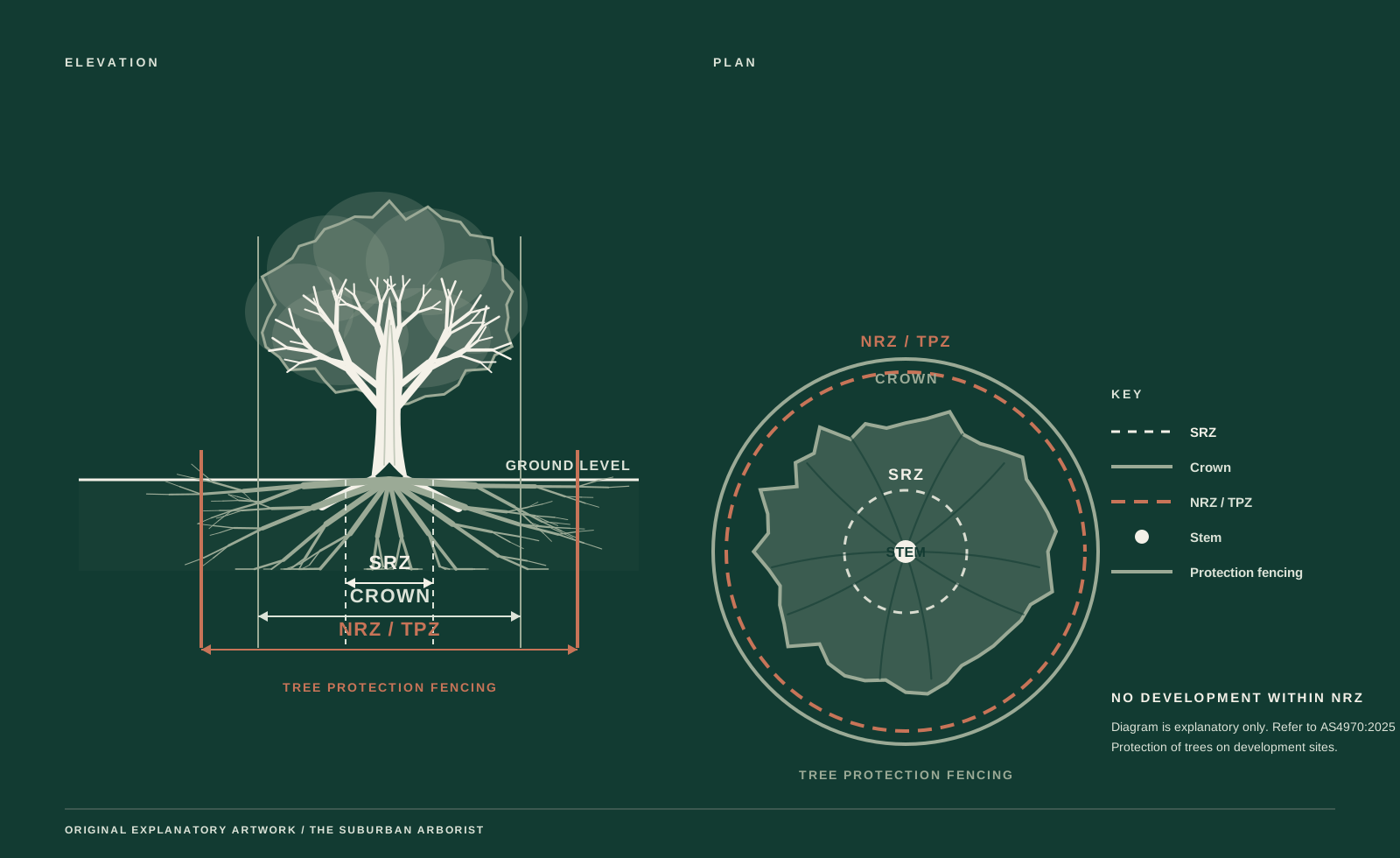
The Notional Root Zone identifies the area considered important for tree viability. The Structural Root Zone identifies the area required for structural stability.
These zones can be overlaid on architectural, engineering, landscape and service drawings so the project team can compare options and identify where further assessment may be required.
The calculations and terminology align with AS4970:2025 Protection of trees on development sites.
The final protected area and construction-phase measures are confirmed later, once the development layout and likely impacts are known.
Preliminary recommendations
Where practical, use existing footprints, access points and disturbed areas to reduce new encroachment into important root zones.
Shift the building, slab edge, footing system, excavation, finished levels or service route where a sympathetic alternative is available.
Targeted root investigation may be recommended where the location or significance of roots could materially affect the design response.
Preliminary report or impact assessment?
Prepared during early planning, before the design is fixed. It identifies the trees, retention values and root-zone constraints that should inform the layout.
Prepared after the design has progressed. It assesses likely development impacts and explains the design modifications and protection measures required for retained trees.
Some projects require both reports as the design moves from feasibility and concept planning into a planning application.
Who the report supports
Information to provide
Frequently asked questions
Ideally after the feature and level survey is available and before the development layout is fixed. This gives the design team the greatest opportunity to respond to tree constraints.
A feature and level survey is the most useful starting point. Concept drawings are helpful when available, but the report can be prepared before a detailed design exists.
Relevant neighbouring trees can be assessed where they may influence the site or proposed works and where lawful access and suitable observations are available.
No. A preliminary report identifies early constraints before the design is fixed. An impact assessment evaluates a developed proposal against the trees and root zones.
The report may provide useful tree information, but a removal application may require a different site-specific scope depending on the relevant planning scheme, overlay or local law.
No. The report provides arboricultural evidence and professional recommendations. Planning and permit decisions remain with the relevant authority.
Start with the site
Share the property address, project stage and any survey or design information currently available.
[email protected] 0401 766 127Consulting across Melbourne & Victoria
Subject to service-area eligibility.
Service area note: Consulting work cannot currently be accepted for properties within Maroondah municipality due to a professional conflict-of-interest requirement.